Why Did God Forbid Tattoos?
Leviticus 19:28, Faith, and Making Peace With the Marks We Carry
Michael E. Hattaway (Retired)
Hattaway Creative Publishing
Why Did God Forbid Tattoos? Leviticus 19:28, Faith, and Making Peace With the Marks We Carry
Copyright © 2026 Michael E. Hattaway. All rights reserved.
Published by Hattaway Creative Publishing, an imprint of Hattaway Creative Holdings LLC.
Edited by Ian M. E. Hattaway.
No part of this book may be reproduced in any form without written permission from the publisher, except for brief quotations in reviews.
Scripture quotations are from the Authorized (King James) Version, which is in the public domain in the United States. Rights in the Authorized Version in the United Kingdom are vested in the Crown.
This book is for education and spiritual reflection. It is not pastoral, legal, or medical advice. Talk with your pastor, priest, rabbi, imam, or other trusted teacher about questions of conscience, and with a licensed clinician about health questions.
The stories marked as composites draw on common experiences. Names and details are illustrative.
First edition, 2026
Epigraph
“Ye shall not make any cuttings in your flesh for the dead, nor print any marks upon you: I am the LORD.”
Leviticus 19:28 (KJV)
“Behold, I have graven thee upon the palms of my hands.”
Isaiah 49:16 (KJV)
Dedication
To my five sons. May you read every verse in its place, hold every conviction with humility, and never mistake a mark on the skin for the measure of a person.
And to everyone who was ever judged by their skin before anyone asked about their story.
Contents
1. Preface: Why I Wrote This Book
2. Introduction: The Question Behind the Question
3. Part I: The Question
4. Chapter 1: One Verse, Many Verdicts
5. Chapter 2: The Word Used Once
6. Chapter 3: For the Dead
7. Chapter 4: The Holiness Chapter
8. Part II: Belief, Theology, and Dogma
9. Chapter 5: Text, Teaching, and Rule
10. Chapter 6: What Christian Traditions Teach Today
11. Chapter 7: Judaism and Islam
12. Part III: Personal Introspection
13. Chapter 8: Why Do You Want It?
14. Chapter 9: Before the Ink
15. Part IV: Reconciliation
16. Chapter 10: Making Peace With God
17. Chapter 11: Making Peace With Yourself and Others
18. Chapter 12: In the Chair: Honor, Safety, and Healing
19. Questions People Ask
20. A Thought Experiment: Two People in the Same Pew
21. Closing: The Mark That Lasts
22. About the Author
23. Acknowledgments
24. Appendix A: Key Passages
25. Appendix B: Word Notes
26. Appendix C: The Before the Ink Worksheet
27. Appendix D: Study Guide for Groups and Individuals
28. Appendix E: Tattoo Readiness and Aftercare Checklist
29. Appendix F: Glossary
30. Appendix G: My Hands, Unedited
31. References
Preface: Why I Wrote This Book
I grew up in the Assembly of God church, part of the Assemblies of God, the world’s largest Pentecostal denomination. My grandfather was an Assembly of God pastor who retired after fifty-five years in the pulpit. My mother was the eldest of eight sisters, raised in that church, and stayed in it her entire life.
Like many Pentecostal churches of that era, ours held strict standards for how a believer looked and lived. We lived by a strict reading of the Bible. It shaped what we wore, whether we wore jewelry, whether we danced, what music we listened to, and, of course, whether anyone in the family would ever get a tattoo.
Around age fifteen, I began exploring religious philosophy and eschatology, the study of the last things (death, judgment, and the end of the age), on my own. The questions got bigger than the answers I had been handed. As I grew into adulthood, I moved toward the tenets and lifestyle of Stoicism rather than the strict church life I was raised in.
I got my first tattoo in the United States Marine Corps, at nineteen. It represented my experience in the Corps and in war.
I lost count somewhere along the way. When I finally sat down and counted, there were seventy-five pieces, and every one of them was hand-chosen and drawn with exact meaning before it was applied to my skin. Memorials. Markers of my own journey. My heritage, from my Choctaw side to my Scottish, Welsh, and English side. My beliefs. Dedications to people, places, and seasons of my life. I have full sleeves and tattoos on my hands, knuckles, neck, throat, legs, back, and hips.
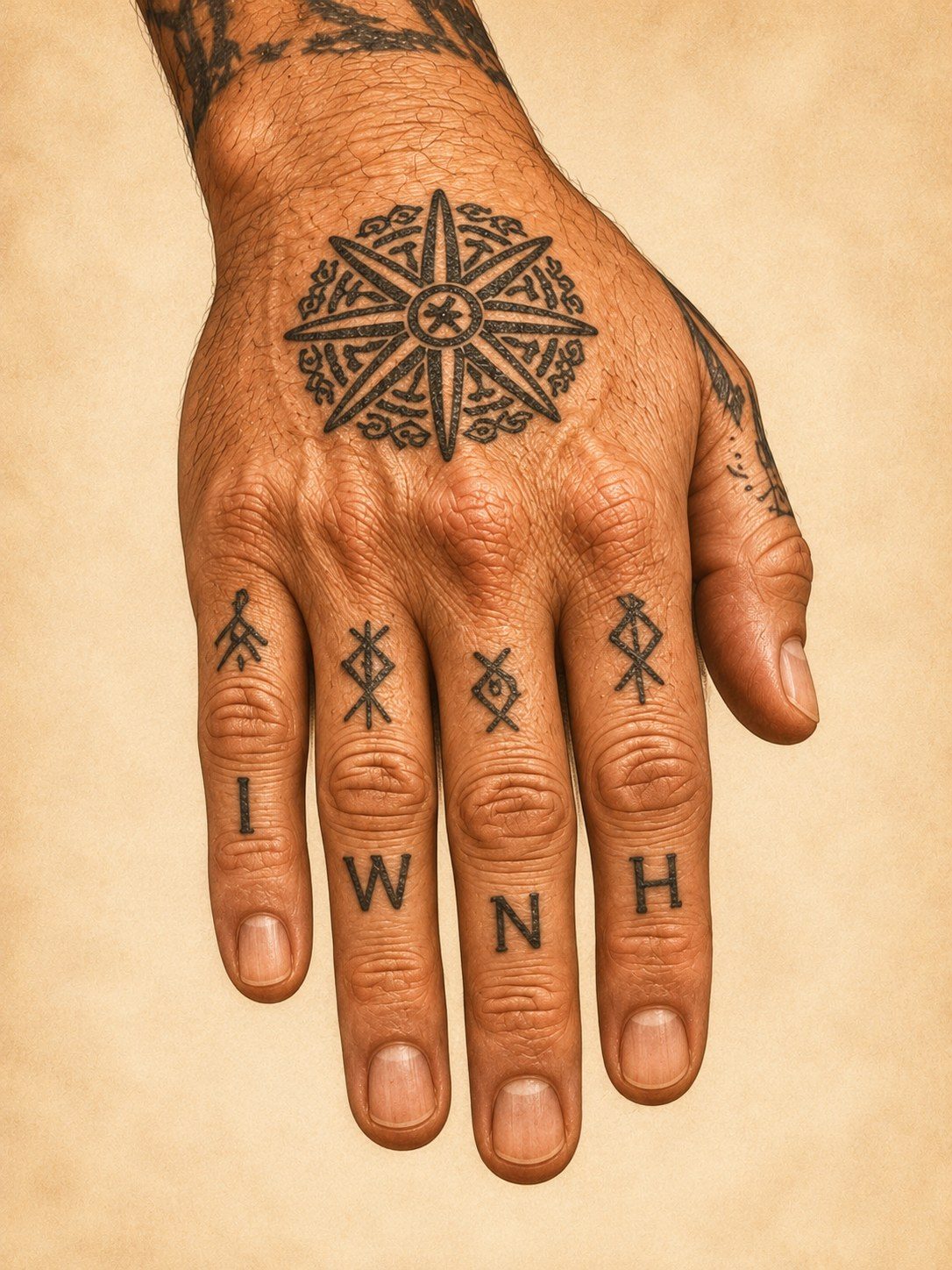
Illustration based on the author’s hands. Unedited photographs appear in Appendix G.
My right hand. I W N H: I Was Never Here. During World War II, a shipyard inspector named James Kilroy is widely credited with chalking “Kilroy was here” on the work he checked, and the phrase followed American servicemen around the world. Kilroy wanted the world to know he had been there. My hand says the opposite. This body is the vessel. My spirit is only visiting the flesh, and in the end I was never really here.
Kilroy’s name is the part everyone remembers, but it was never his real mark. His real mark was the rivets he checked, the ones that held when the ships went to sea. That is the kind of mark I want to leave. Not proof that I was here, but work that holds after I am gone.
The runes beneath the letters are for navigation and protection, and the stave on the back of my hand is a wayfinder. Search these marks and you will find words like “Viking” and “pagan.” What I asked for was simpler: guide me, and guard me on the way. Some of these runes were later stolen by people who used them for hate. They were symbols long before that, and on my hand they mean what I put there.
Reflection: If you were never really here, what would you want to have held?
For most of my life, almost all of it stayed covered. As a young Marine, then as a veteran, then through a career in health care and leadership, my ink lived under my sleeves and only peeked out now and then. I understood the stigma, and I chose discretion.
I never felt guilt about my tattoos. I felt pride. But I always considered them personal, carrying meaning for my own reasons.
When I retired, my body finally became the canvas I had always wanted it to be. Today I wear my ink openly and do not worry much about what others think it means.
So why write this book?
Because I have lived on both sides of the question. I was raised by people who would have quoted Leviticus 19:28 with total conviction, and I love them. I have also spent nearly three decades in mental health and health care, watching people mark their bodies for every reason you can imagine. And I carry the marks myself.
This book is not about my theology, my eschatology, or my dogma: what I believe about God, how I believe the story ends, or which teachings I hold as binding. It is about the question itself, “Why did God forbid tattoos?”, set beside the many ways people of faith have answered it, and about the honest look inward that every reader deserves to take.
Michael E. Hattaway (Retired)
Introduction: The Question Behind the Question
“Why did God forbid tattoos?”
It sounds like a simple question. It is actually three questions folded into one.
The first is about the text. Did God forbid tattoos? What does the verse actually say, and to whom?
The second is about belief. If God did forbid something, does that command still apply to me? Your answer depends on your tradition, your church, and how you read the relationship between the Old and New Testaments.
The third is about you. Why are you asking? Maybe you want a tattoo and feel uneasy. Maybe you already have one and carry guilt. Maybe someone you love has one, and you are not sure how to feel. Maybe you were the one who quoted the verse at someone and now wonder if you were right.
This book takes all three seriously.
Why the question matters now
This is not a niche question. A 2023 Pew Research Center survey found that 32 percent of American adults have a tattoo, and 22 percent have more than one. Among those with tattoos, 69 percent said they got at least one to honor or remember someone or something, and 47 percent said they got one to make a statement about what they believe. About a quarter, 24 percent, said they regret at least one of their tattoos.
In other words, tattoos are now ordinary. They are often deeply personal and frequently tied to faith and grief. That is exactly where Leviticus 19:28 lives.
How the book is built
Part I, The Question, reads Leviticus 19:28 slowly: its words, its grammar, its chapter, and the world it was written into.
Part II, Belief, Theology, and Dogma, looks at how different communities answer the question today. We separate three things that often get blurred: what the text says, what teachers interpret it to mean, and what a tradition actually requires of its members.
Part III, Personal Introspection, turns the question inward. Why do you want a mark? What is it carrying for you?
Part IV, Reconciliation, is about peace: with God, with yourself, and with the people around you. It ends in the artist’s chair, with practical guidance on safety and healing.
Each chapter closes with an Action Step and a Reflection Prompt. Along the way, I share pieces of my own story: a pastor’s grandson, a Marine, a man who gave nearly three decades to mental health and health care, and a man with seventy-five tattoos, under the heading “From My Own Skin,” and reflections on design and meaning under “From the Artist’s Chair.”
A promise
I will not tell you what to do with your skin. I will tell you what the Scripture says, what it does not say, and what thoughtful people on each side believe. The decision belongs to you before God.
If you are carrying guilt, I hope you find grace. If you are carrying judgment, I hope you find humility. If you are simply curious, I hope you find a clearer way to read your Bible.
Action Step: Write down, in one sentence, what you believe right now about why God forbade tattoos. Keep it. Return to it at the end.
Reflection Prompt: Which of the three questions is really yours: the text, the belief, or the personal one?
Part I: The Question
Before we can ask whether a command applies to us, we have to know what it says.
Chapter 1: One Verse, Many Verdicts
Ask ten Christians what the Bible says about tattoos, and you will hear at least four answers.
The first says tattoos are forbidden, full stop. Leviticus 19:28 is clear: God does not change, and that settles it.
The second says tattoos are fine, full stop. That was the Old Testament. We live under grace now.
The third says tattoos are permitted but unwise. You are free, but freedom is not the same as wisdom.
The fourth says it depends on the tattoo. A cross is different from a demon. A memorial to your mother is different from a joke you will regret by Thursday.
Notice what all four have in common. Each is a verdict. Very few begin with a reading.
Why the shortcut fails
When we reach for a single verse to settle a question, we usually want certainty more than understanding. That is human. It is also risky. A verse pulled out of its setting can be made to say almost anything.
Scripture asks for more. Paul told Timothy to be a workman who “needeth not to be ashamed, rightly dividing the word of truth” (2 Timothy 2:15). Rightly dividing means handling the text with care: noticing who is speaking, to whom, about what, and why.
Three questions for any command
1. What does it say? The actual words, in their language and their sentence.
2. What did it mean then? To the first people who heard it, in their world.
3. What does it mean now? For a believer living under the New Covenant, in a very different culture.
Most arguments skip straight to the third question. This book will not.
What is at stake
This is not only about ink. It is about how we read the Bible, how we treat one another, and how we carry our own bodies before God. If we read one verse carelessly, we will read others carelessly. If we judge one person by their skin, we will judge others by their surface.
A Story: The Dinner Table
A composite drawn from common experiences.
Elena was nineteen when she came home from her first semester with a small cross on the inside of her wrist. She thought her mother would be proud. It was a cross, after all.
Her mother saw it before Elena sat down. She set her fork on the plate and said one sentence: “Leviticus 19:28.” Nobody spoke for the rest of the meal.
For two years, the tattoo stood between them like a wall. Elena stopped going to church. Her mother stopped asking why.
A question finally broke the silence. One night Elena asked, “Mom, what does the verse before that one say?” Her mother did not know. They opened the Bible together at the kitchen table and read Leviticus 19 slowly, for the first time.
They did not agree on everything that night. But for the first time in two years, they were reading instead of rendering verdicts. That is where reconciliation began.
Action Step: Read Leviticus 19 aloud, all 37 verses, in one sitting.
Reflection Prompt: Which of the four verdicts have you held, and did you reach it by reading or by inheriting it?
Chapter 2: The Word Used Once
“Ye shall not make any cuttings in your flesh for the dead, nor print any marks upon you: I am the LORD.” (Leviticus 19:28)
The verse has two commands and one reason.
The first command: cuttings for the dead
The Hebrew word for cutting, seret, refers to a gash or laceration. The following phrase ties it directly to the dead. This is not a general rule about scratches or surgery. It refers to a specific act for a specific reason: wounding yourself as part of mourning.
The second command: the marks
The second half is where the tattoo debate lives. The Hebrew phrase is ketovet qa’aqa.
Ketovet comes from the root for writing. It means an inscription, something written or imprinted.
Qa’aqa appears only here in the entire Hebrew Bible. Scholars call a word like this a hapax legomenon, a word used once. Lexicons give meanings like incision, imprint, or tattoo, though the root is uncertain.
Put together, the phrase means something like “an inscription of incision”: a permanent mark made by breaking the skin.
What we can and cannot know
When a word appears once, we cannot compare it with other uses to sharpen its meaning. That calls for humility on every side.
We can say the verse forbids some permanent mark cut or pressed into the skin. Rashi, the great medieval Jewish commentator, described it as writing that sinks in and cannot be erased. The Mishnah, an early collection of Jewish law, defined the forbidden act as requiring both an incision and the insertion of ink.
We cannot say with certainty whether the first hearers pictured decorative ink, ritual scarring, a brand of ownership, or a mix. Some scholars connect the marks to signs placed on enslaved people or temple servants to show who owned them. Others connect them to the mourning rites in the first half of the verse.
We do know, though, that tattooing was not new in Moses’ world. Preserved human remains show tattoos more than five thousand years old, and archaeologists have found tattooed mummies in ancient Egypt. Israel’s neighbors knew how to mark the skin, which is why the command needed to be given at all.
The only reason given
Then comes the reason: “I am the LORD.”
This is the most important thing to notice in the whole book. The verse does not explain why. It does not say tattoos are unhealthy, ugly, or immodest. It gives one reason: a claim of belonging. God is saying, “You are Mine.”
That phrase appears again and again in Leviticus 19. Israel’s bodies, grief, worship, and whole lives were to show that they belonged to God and not to the powers their neighbors served.
So the honest answer to “Why did God forbid tattoos?” begins here. The text gives us identity and ownership. Every other reason you have heard is an interpretation. Some interpretations are wise. But they are interpretations.
Action Step: Write the verse on a card. Underline “for the dead” and “I am the LORD.” Keep it in your Bible for the rest of this study.
Reflection Prompt: If the heart of this verse is “You belong to Me,” where in your life is that claim being tested right now, apart from your skin?